Contact us for a Free Quote today

Running a commercial property in Indianapolis means juggling a lot of responsibilities, and one that too many property owners overlook is ADA parking lot requirements. Whether you manage a retail center in Carmel, an office building in Fishers, or a medical facility in downtown Indianapolis, your parking lot must meet specific accessibility standards under the Americans with Disabilities Act. Getting this wrong doesn’t just put you at risk of fines, it sends the wrong message to customers, employees, and visitors who depend on accessible parking every single day.
In this guide, we break down the ADA parking lot requirements that Indiana property owners and managers need to understand, from the number of accessible spaces you need to the exact dimensions, signage, and surface conditions that keep you compliant and out of trouble.
The Americans with Disabilities Act sets federal standards for accessible parking at every commercial property in the United States. These requirements exist to ensure that people with disabilities have safe, practical access to businesses, government buildings, medical facilities, and other public spaces.
In Indiana, ADA parking lot requirements are based on the 2010 ADA Standards for Accessible Design. These standards spell out exactly how many accessible spaces you need, how big they must be, where they need to be located, and what signage and markings are required. Indiana also adds its own layer of requirements on top of the federal rules, including a mandate that all accessible parking striping must be painted in blue.
If your parking lot doesn’t meet these standards, you could face federal fines, local code violations, or even lawsuits from individuals who were unable to access your property. The good news is that compliance is straightforward once you understand the rules, and it often comes down to proper striping, signage, and surface maintenance.
One of the most common questions Indianapolis property owners ask is how many ADA-compliant spaces they actually need. The answer depends entirely on the total number of parking spaces in your lot.
Here is the breakdown based on IC 5-16-9-2 of the Indiana State Code:
These numbers are the minimum. Some property types, especially medical facilities, require significantly more accessible spaces, which we cover later in this article.
Keep in mind that the count applies to each parking facility on your site individually. If your Indianapolis property has both a parking lot and a parking garage, each one needs its own allocation of accessible spaces based on its own total count.
Not all accessible spaces are created equal. Federal ADA standards require that at least one out of every six accessible parking spaces must be van-accessible. If your lot requires six accessible spaces, at least one must accommodate a van.
Van-accessible spaces have larger dimensions to allow for wheelchair lift deployment from the side of the vehicle. This isn’t optional, it’s a core part of ADA parking lot requirements that many property owners in Indiana overlook during restriping projects.
Getting the dimensions right is critical. A space that’s too narrow or missing an access aisle doesn’t just fail an inspection, it creates real problems for people who depend on these spaces.
Standard car-accessible parking spaces must be at least 96 inches (8 feet) wide with an adjacent access aisle that is at least 60 inches (5 feet) wide. The total width of the space plus the aisle is at least 13 feet.
Van-accessible spaces must be at least 8 feet wide with an access aisle that is at least 8 feet wide, for a total of 16 feet. Alternatively, the space itself can be 11 feet wide with a 5-foot access aisle.
Van-accessible spaces also require a minimum vertical clearance of 98 inches (just over 8 feet) along the entire vehicular route to and from the space, including the parking space itself and the access aisle. This is especially important in parking garages and covered lots around Indianapolis.
Access aisles are the hatched areas adjacent to accessible parking spaces. These are not decoration, they provide the room people need to deploy wheelchair ramps, lifts, and mobility equipment from their vehicles.
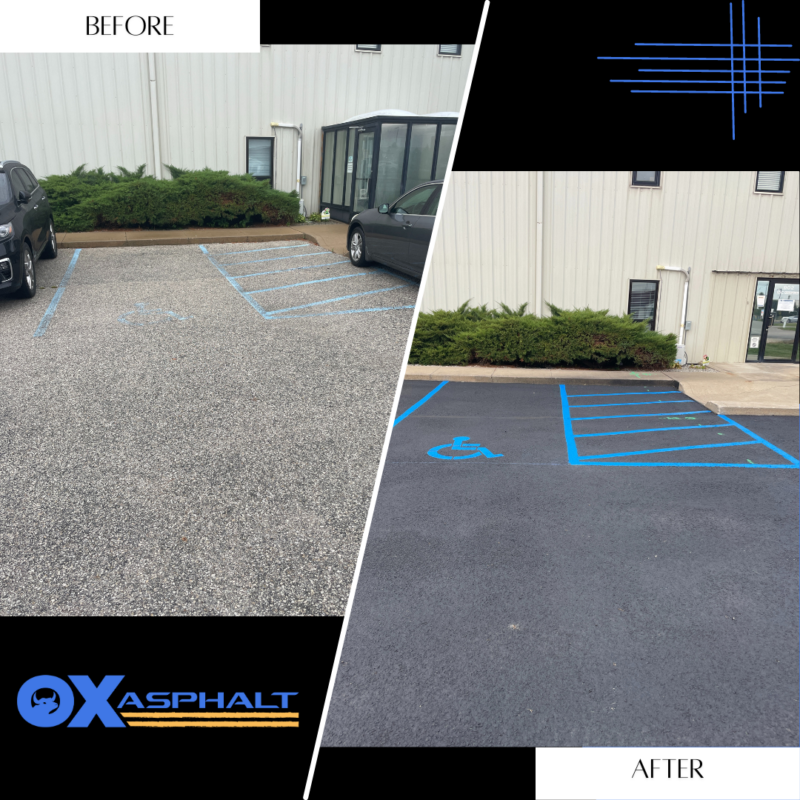
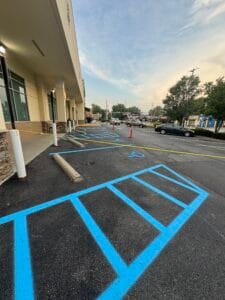
Access aisles must be clearly marked, typically with diagonal hatch lines, to discourage other drivers from parking in them. In Indiana, these markings must be blue. Two adjacent accessible spaces can share a single access aisle between them, which is a practical way to save space while staying compliant.
The surface of the access aisle must be firm, stable, and slip-resistant, with a slope no steeper than 1:48 in any direction. If your parking lot has settled, cracked, or developed uneven surfaces over time, those aisles may no longer meet the slope requirement, which is a compliance issue that an asphalt maintenance professional can address.
Proper signage is one of the easiest parts of ADA compliance to get right, but it’s also one of the most commonly cited violations during inspections.
Every accessible parking space must have a sign that includes the International Symbol of Accessibility (the blue and white wheelchair symbol). Van-accessible spaces need an additional designation that reads “Van Accessible” on the sign.
All ADA parking signs must be mounted so that the bottom of the sign is at least 60 inches (5 feet) above the ground. This ensures the signs remain visible even when a vehicle is parked in the space.
Ground-level pavement markings alone do not satisfy the signage requirement. You need both the pavement markings and the posted signs. Many Indianapolis property owners make the mistake of thinking that painted symbols on the asphalt are enough, they’re not.
Indiana does provide one exception for very small parking lots. If your lot has four or fewer total spaces, you still need to provide accessible spaces, but those spaces do not need signs. Additionally, anyone, with or without a disability, can park in those accessible spaces. This exception exists so that tiny businesses aren’t forced to reserve a disproportionate share of their limited parking.
For any lot with five or more spaces, full signage is required with no exceptions.
Where you place your accessible parking spaces matters just as much as how many you have and how big they are.
ADA standards require accessible spaces to be located on the shortest accessible route to the building’s accessible entrance. This means they should be the closest spaces to the front door, not tucked away in a far corner of the lot.
The accessible route from the parking space to the entrance must meet its own set of standards. It must be at least 36 inches wide, have a firm and stable surface, and be free of any curbs or stairs. If there are elevation changes, ramps with a slope no steeper than 1:12 must be provided.
For Indianapolis properties with multiple buildings or entrances, each entrance needs its own set of accessible spaces located as close as possible. You cannot consolidate all of your accessible parking in one area if your property has multiple access points.
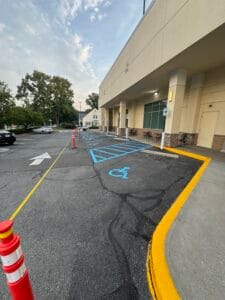
This is where parking lot maintenance and ADA compliance directly intersect. The accessible route, including the parking space, access aisle, and path to the entrance, must have a surface that is firm, stable, and slip-resistant.
Cracked asphalt, potholes, standing water, loose gravel, and uneven surfaces all create barriers that can make an accessible route non-compliant. In Indiana, our freeze-thaw cycles are especially hard on pavement, and a parking lot that was compliant last spring might have new cracks and heaving by this spring.
Regular crack sealing and surface maintenance are not just about curb appeal, they’re about keeping your parking lot accessible and meeting your legal obligations under the ADA.
While the federal ADA Standards provide the baseline, Indiana has its own additional requirements that property owners must follow. The most notable one is the blue striping rule.
Under Indiana Code IC 5-16-9-4(a)(6), all accessible parking spaces and access aisles must be designated with blue lines. The federal ADA standards do not specify a color for striping, but Indiana law does. If your accessible spaces are striped in white or yellow, you may be in compliance with federal law but in violation of Indiana state code.
When you restripe your parking lot, make sure your contractor uses blue paint for all accessible spaces and aisles. This is a simple detail that’s easy to get right when you’re aware of it, and easy to get wrong if you’re not.
Non-compliance with ADA parking requirements in Indiana can result in fines ranging from $1,500 to $10,000 or higher depending on the violation. Federal penalties can be even steeper, first-time violations of the ADA can carry fines up to $75,000.
Beyond fines, property owners can face lawsuits from individuals who were unable to access their property due to non-compliant parking. These cases have become more common in recent years, and the cost of defending against even a single ADA lawsuit can far exceed the cost of bringing your lot into compliance.
The bottom line: maintaining ADA compliance is far cheaper than dealing with the consequences of ignoring it.
If your Indianapolis property includes a medical facility, you face significantly higher accessible parking requirements than a standard commercial property.
Hospital outpatient facilities must provide accessible parking for at least 10% of all patient and visitor parking spaces. Rehabilitation facilities and outpatient physical therapy centers must provide 20% accessible parking. At least one out of every six of those accessible spaces must be van-accessible.
These higher requirements reflect the fact that medical facilities serve a higher proportion of patients with disabilities and mobility limitations. If you manage or own a medical property in Indiana, it’s worth having a parking lot professional assess your current layout to make sure you meet these elevated standards.
Many property owners wonder whether they need to bring their parking lot up to ADA standards if it was built before the ADA was enacted in 1990. The short answer is that ADA compliance is an ongoing obligation, not a one-time event.
Any time you restripe your parking lot, you must bring your accessible parking into compliance with the current 2010 ADA Standards. This is one of the most common triggers for compliance and catches many Indianapolis property owners off guard. Even if your lot hasn’t been fully repaved, a routine restriping project means your accessible spaces must meet current dimensions, quantities, and marking requirements.
Businesses that serve the public have a continuing obligation to remove barriers to access when it is “readily achievable” to do so. Because restriping is relatively inexpensive, it is considered readily achievable in most cases. This means you generally cannot argue that bringing your parking lot striping into compliance is too costly or burdensome.
Any new parking lot construction or major alteration must fully comply with the 2010 ADA Standards from day one. If you are building a new lot or doing a full repaving project, this is the time to get everything right, layout, dimensions, signage, and surface conditions.
Space Count: Do you have the correct number of accessible spaces based on your total lot size? Is at least one out of every six van-accessible?
Dimensions: Are standard accessible spaces at least 8 feet wide with a 5-foot access aisle? Are van-accessible spaces at least 8 feet wide with an 8-foot access aisle (or 11 feet with a 5-foot aisle)?
Signage: Does every accessible space have a posted sign with the International Symbol of Accessibility at least 60 inches above ground? Do van spaces say “Van Accessible”?
Blue Striping: Are all accessible spaces and access aisles marked with blue lines per Indiana code?
Location: Are accessible spaces on the shortest route to the accessible entrance?
Accessible Route: Is there a continuous, barrier-free path from the accessible spaces to the building entrance that is at least 36 inches wide?
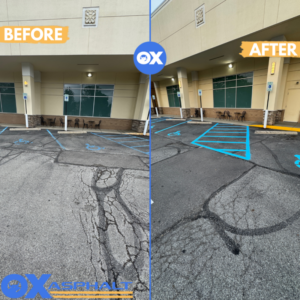
Surface Condition: Is the pavement firm, stable, and slip-resistant throughout the accessible spaces, aisles, and routes? Are there any cracks, potholes, or uneven surfaces that need repair?
Slope: Is the slope of accessible spaces and aisles no steeper than 1:48 in any direction?
If you answered “no” to any of these, it’s time to address those gaps before they lead to fines, lawsuits, or, most importantly, real accessibility barriers for people who need those spaces.
ADA compliance isn’t just about striping and signage, the physical condition of your pavement plays a major role. A parking lot with deteriorating asphalt can quickly become non-compliant even if the striping and signage are perfect.
Here’s how regular maintenance keeps you compliant:
Crack sealing prevents small cracks from expanding into tripping hazards and uneven surfaces along accessible routes. If you’re not staying ahead of cracks, check out our guide on asphalt crack sealing in Indianapolis to understand why it matters.
Sealcoating protects the asphalt surface from UV damage, water penetration, and chemical spills that can degrade the pavement over time. A well-maintained surface stays firm, stable, and slip-resistant, exactly what the ADA requires. Learn more about how often you should sealcoat your parking lot to keep your lot in top condition.
Pothole repair and patching eliminates the most obvious accessibility barriers. A pothole in an access aisle or along the accessible route is a direct ADA violation and a safety hazard.
Regular inspections catch problems early. Indiana’s weather, especially our harsh freeze-thaw cycles, can create new compliance issues every season. A proactive maintenance schedule helps you spot signs that your parking lot needs attention before they become violations.